1.2 - Who Must Be Certified
Regulatory verification date: August 5, 2026
Primary authority: 40 CFR §§ 82.152 and 82.161
Course role: Defines the activities, persons, exceptions, and supervision conditions that determine when EPA Section 608 technician certification is required
Learning Objectives
After completing this section, a student should be able to:
- State the regulatory meaning of a Section 608 technician.
- Determine whether a maintenance, service, repair, installation, or disposal activity requires Section 608 certification.
- Identify activities that are reasonably expected to violate the integrity of a refrigerant circuit.
- Distinguish activities that require certification from activities that do not normally affect the refrigerant circuit.
- Explain why attaching gauges or hoses may require certification even though this action is not defined as “opening an appliance.”
- Apply the special disposal exceptions for small appliances, motor-vehicle air conditioners, and MVAC-like appliances.
- Explain the requirements and limitations of the registered-apprentice exemption.
- Distinguish formal classroom laboratory work from uncertified on-the-job training.
- Explain why job title, equipment ownership, or lack of payment does not automatically remove the certification requirement.
- Apply the certification requirement to representative field and laboratory scenarios.
Introduction
Section 608 certification requirements are based primarily on what a person does, not on the person’s job title.
A person does not avoid the certification requirement simply because the person is called an:
- Installer.
- Maintenance employee.
- Facilities engineer.
- Building owner.
- Equipment operator.
- Student.
- Helper.
- Contractor.
- Homeowner.
The controlling question is whether the person performs an activity that could reasonably be expected to violate the integrity of the refrigerant circuit and release refrigerant.
For maintenance, service, and repair, the Section 608 definition generally applies to appliances other than motor-vehicle air conditioners. For disposal, the definition includes an important exception for small appliances, motor-vehicle air conditioners, and MVAC-like appliances. Those disposal exceptions do not mean that refrigerant may be vented or that the equipment may be discarded without satisfying applicable recovery and safe-disposal requirements.
This section develops a practical decision process for determining who must be certified.
Key Concepts
1. The Regulatory Definition of a Technician
Under 40 CFR § 82.152, a technician is a person who, during maintenance, service, or repair of an appliance other than a motor-vehicle air conditioner, could reasonably be expected to violate the integrity of the refrigerant circuit and release refrigerant.
The definition also covers a person who, during disposal of an appliance other than a small appliance, motor-vehicle air conditioner, or MVAC-like appliance, could reasonably be expected to violate the refrigerant circuit and release refrigerant.
The definition is based on four elements:
| Element | Question to Ask |
|---|---|
| Person | Is an individual performing the activity? |
| Appliance | Is the work being performed on refrigeration or air-conditioning equipment covered by the rule? |
| Activity | Is the person maintaining, servicing, repairing, installing, or disposing of the appliance? |
| Refrigerant circuit | Could the work reasonably violate the integrity of the circuit and release refrigerant? |
If the answer to the applicable questions is yes, the person generally must hold the appropriate Section 608 certification unless a specific exemption applies.
2. The Refrigerant Circuit Is the Controlling Boundary
The refrigerant circuit consists of the appliance parts that are normally connected to one another, or separated only by internal valves, and are designed to contain refrigerant.
Typical refrigerant-circuit components include:
- Compressor.
- Condenser.
- Evaporator.
- Receiver.
- Accumulator.
- Refrigerant piping.
- Service valves.
- Access fittings.
- Metering device.
- Refrigerant-containing coils.
- Connections and subassemblies designed to contain refrigerant.
Certification is generally required when an activity could cause refrigerant to escape from this circuit.
The rule does not require refrigerant to be released before certification becomes necessary. The key phrase is could reasonably be expected to violate the circuit and release refrigerant.
3. Activities That Require Certification
EPA identifies the following activities as examples of work that is reasonably expected to violate the refrigerant circuit:
- Attaching hoses or gauges to an appliance.
- Detaching hoses or gauges from an appliance.
- Adding refrigerant.
- Removing refrigerant.
- Adding a refrigerant-circuit component.
- Removing a refrigerant-circuit component.
- Cutting a refrigerant line.
Other common activities that generally require certification include:
- Recovering refrigerant before service.
- Charging an appliance after repair.
- Replacing a compressor in a charged system.
- Replacing an evaporator or condenser.
- Opening a service valve to connect a precharged line set.
- Connecting or disconnecting a precharged mini-split line.
- Removing a refrigerant-containing component for repair or disposal.
- Installing equipment when the installation activity can release refrigerant.
- Disposing of a covered appliance when the work can violate the circuit and no disposal exception applies.
The list is not limited to these examples. Any activity that could reasonably compromise the refrigerant circuit must be evaluated.
4. Attaching Gauges Requires Certification
Connecting a manifold gauge set or another pressure-measuring hose to an appliance generally requires Section 608 certification.
This is important because connecting and disconnecting hoses can:
- Release refrigerant trapped in the service hose.
- Depress a Schrader valve or other service fitting.
- Introduce air or moisture.
- Cause refrigerant loss if the connection is defective.
- Release refrigerant during disconnection.
A common examination trap is the distinction between technician activity and opening an appliance:
- Attaching or detaching hoses and gauges is a technician activity that generally requires certification.
- The regulations state that connecting or disconnecting hoses and gauges to measure pressure, add refrigerant, or recover refrigerant is not classified as “opening an appliance.”
These two statements are not contradictory. An activity may require certification even though it does not satisfy the narrower regulatory definition of opening an appliance.
5. Installation May Require Certification
Installation is not automatically exempt.
An installation activity requires Section 608 certification when it could reasonably be expected to violate the refrigerant circuit. Examples include:
- Adding refrigerant during startup.
- Removing refrigerant to correct an overcharge.
- Connecting precharged refrigerant lines.
- Disconnecting precharged lines.
- Opening service valves as part of a refrigerant-circuit connection.
- Cutting, brazing, or mechanically joining refrigerant piping that contains or will release refrigerant.
- Connecting service gauges during commissioning.
EPA specifically identifies installation of a mini-split as requiring certification when the work involves adding or removing refrigerant or connecting or disconnecting hoses or precharged refrigerant lines.
An installer performing only non-refrigerant work may not be acting as a technician for that limited activity. Examples might include setting an equipment pad or mounting an indoor cabinet before any refrigerant-circuit work begins. The complete installation, however, often includes activities that require certification.
6. Job Title Does Not Determine Certification
The following persons may be technicians when they perform covered activities:
- Installation personnel.
- Contractor employees.
- In-house maintenance personnel.
- Facilities staff.
- Building owners.
- Equipment operators.
- Homeowners.
- Independent service technicians.
- Refrigeration mechanics.
- Engineering laboratory personnel performing field-like service work.
The following statements do not create an automatic exemption:
- “I own the equipment.”
- “I am not being paid.”
- “I am only helping.”
- “I am an engineer.”
- “I am a student.”
- “My job title is electrician.”
- “The appliance belongs to my employer.”
The activity and its potential effect on the refrigerant circuit control the determination.
7. Activities That Do Not Normally Require Certification
EPA identifies several activities that are not reasonably expected to violate the integrity of the refrigerant circuit.
Examples include:
- Painting an appliance.
- Rewiring an external electrical circuit.
- Replacing insulation on a length of pipe.
- Tightening nuts and bolts that do not open or disturb the refrigerant circuit.
Activities performed on an appliance that has already been properly evacuated in accordance with the applicable service-practice requirements are not normally expected to release refrigerant, unless the activity includes adding refrigerant.
The distinction is summarized below.
| Activity | Certification Generally Required? | Reason or Condition |
|---|---|---|
| Attach a pressure gauge or service hose | Yes | Connection can affect the refrigerant circuit and release refrigerant |
| Disconnect a pressure gauge or service hose | Yes | Refrigerant may be released during disconnection |
| Add refrigerant | Yes | Direct refrigerant-handling activity |
| Remove or recover refrigerant | Yes | Direct refrigerant-handling activity |
| Remove a compressor from a charged system | Yes | Violates the refrigerant circuit |
| Cut a charged refrigerant line | Yes | Violates the refrigerant circuit |
| Connect precharged mini-split lines | Yes | Connection can release refrigerant |
| Paint the appliance cabinet | No, for that activity | Does not normally affect the refrigerant circuit |
| Rewire an external electrical circuit | No, for that activity | Does not normally affect the refrigerant circuit |
| Replace external pipe insulation | No, for that activity | Does not normally affect the refrigerant circuit |
| Tighten unrelated cabinet nuts and bolts | No, for that activity | Does not normally affect the refrigerant circuit |
| Perform mechanical work after proper evacuation | Generally no, for that activity | The refrigerant has already been properly removed; adding refrigerant still requires certification |
| Add refrigerant after work on an evacuated appliance | Yes | Adding refrigerant is a covered activity |
Important: “No certification required” in this table applies only to the specific listed activity. It does not authorize the same person to perform another covered refrigerant-circuit activity.
8. Disposal Has Special Certification Exceptions
The technician definition treats disposal differently from maintenance, service, and repair.
For disposal activities, Section 608 technician certification is generally required when a person could violate the refrigerant circuit, except when disposing of:
- Small appliances.
- Motor-vehicle air conditioners.
- MVAC-like appliances.
This exception concerns the technician-certification requirement for the disposal activity. It does not eliminate refrigerant-recovery or safe-disposal responsibilities.
For example, the final disposer of a small appliance must ensure that refrigerant has been recovered in accordance with the applicable safe-disposal requirements. The disposer may rely on a signed statement or other permitted verification that recovery occurred before delivery, but the refrigerant may not simply be vented.
The disposal distinction can be summarized as follows.
| Disposal Scenario | Section 608 Technician Certification for the Disposal Activity | Other Requirements |
|---|---|---|
| Dispose of a residential split system containing refrigerant | Generally required for a person who can violate the circuit | Refrigerant recovery, records, and applicable safe-disposal practices |
| Dispose of a commercial refrigeration appliance | Generally required for a person who can violate the circuit | Refrigerant recovery and applicable documentation |
| Final disposal of a small appliance | Disposal exception from technician definition | Final disposer must ensure refrigerant was recovered |
| Disposal of an MVAC | Not handled as ordinary Section 608 stationary-appliance disposal | Applicable Section 609 and disposal requirements must be followed |
| Disposal of an MVAC-like appliance | Disposal exception from Section 608 technician definition | Applicable recovery and disposal requirements still apply |
Detailed safe-disposal requirements are developed in Module 6.
9. The Registered-Apprentice Exemption
An apprentice may perform covered work before earning certification only when all applicable apprentice conditions are satisfied.
To qualify under the current federal definition, the person must:
- Be registered as an apprentice in appliance maintenance, service, repair, or disposal.
- Be registered with the U.S. Department of Labor’s Office of Apprenticeship or a State Apprenticeship Council recognized by that office.
- Be closely and continually supervised.
- Be supervised by a certified technician who holds the appropriate Section 608 certification for the appliance being serviced.
- Remain within the federal apprentice period, which is limited to two years from the date of first registration.
The apprentice exemption is not created merely by:
- Being newly hired.
- Being called a trainee.
- Enrolling in a trade school.
- Working beside another employee.
- Receiving informal on-the-job instruction.
- Having an employer describe the person as an apprentice.
The registration and supervision conditions matter.
10. Meaning of Close and Continuous Supervision
EPA requires the apprentice to be closely and continually supervised by a properly certified technician.
For course and examination purposes, this means the supervising technician must be in a position to:
- Direct the work.
- Observe the work.
- Intervene when needed.
- Prevent improper refrigerant release.
- Ensure that required procedures and equipment are used.
A supervisor who is unavailable, off-site, or only reachable by telephone would not satisfy the ordinary meaning of close and continuous supervision.
The supervising technician must also hold the certification appropriate to the appliance:
- Type I or Universal for applicable small-appliance work.
- Type II or Universal for applicable high- or very-high-pressure appliance work.
- Type III or Universal for applicable low-pressure appliance work.
11. Formal Classroom Laboratory Work
EPA permits students to perform formal laboratory coursework before obtaining certification.
The allowance applies to genuine course-driven laboratory instruction. It does not automatically apply to:
- On-the-job training.
- Unstructured shop practice.
- Work performed for a customer.
- Routine maintenance at a school.
- Field service presented as a class exercise.
- Informal training that is not part of a formal laboratory course.
On-the-job training that involves covered activities requires the individual to be:
- Properly certified, or
- A registered apprentice working under the required supervision.
For a formal laboratory activity, the school should still use:
- Appropriate safety procedures.
- Proper recovery equipment.
- Suitable cylinders.
- Controlled training equipment.
- Qualified supervision.
- Procedures that minimize refrigerant release.
The classroom allowance is not permission to vent refrigerant or ignore other applicable requirements.
12. Certification Must Match the Appliance
A person may hold Section 608 certification but still lack the correct certification category for the appliance.
Examples:
- Type I certification does not authorize Type II service.
- Type II certification does not authorize Type III service.
- Type III certification does not authorize Type I or Type II service.
- Universal certification covers Types I, II, and III after the required sections are passed.
The certification categories are explained in detail in Section 1.3 - Certification Types.
13. Refrigerant Type Does Not Create a Separate EPA Certification
EPA certification is based primarily on the appliance category, not on a separate credential for each refrigerant.
For example:
- EPA does not require a separate federal “R-410A certification.”
- A manufacturer, school, employer, or industry organization may offer refrigerant-specific training.
- Refrigerant-specific training does not replace the applicable Section 608 certification.
- A technician must still understand the pressures, safety classification, tools, and procedures appropriate to the refrigerant.
This distinction prevents confusion between an EPA credential and voluntary product or refrigerant training.
14. Refrigerant Purchase and Refrigerant Work Are Different Questions
The rule governing who may purchase refrigerant is related to, but distinct from, the rule governing who may perform service.
An employer or authorized representative may be able to purchase or receive refrigerant on behalf of a company that employs a properly certified technician, provided the required evidence is supplied to the seller.
That does not authorize an uncertified office employee, delivery driver, or helper to perform covered refrigerant work.
Always ask two separate questions:
- Is the person authorized to purchase or receive the refrigerant?
- Is the person certified or otherwise permitted to perform the refrigerant-circuit activity?
Refrigerant sales restrictions are covered in Module 2.
Technical and Regulatory Details
1. Decision Process for Certification
Use the following sequence when evaluating an activity.
Step 1 — Identify the Equipment
Determine whether the item is an appliance under Section 608.
Examples include:
- Air conditioners.
- Heat pumps.
- Refrigerators.
- Freezers.
- Chillers.
- Commercial refrigeration systems.
- Small appliances.
Determine whether the equipment is:
- A stationary appliance.
- An MVAC.
- An MVAC-like appliance.
- A small appliance.
- A high-, very-high-, medium-, or low-pressure appliance.
Step 2 — Identify the Activity
Determine whether the person will:
- Install.
- Maintain.
- Service.
- Repair.
- Dispose of.
- Add refrigerant to.
- Remove refrigerant from.
- Attach service equipment to.
- Remove a component from.
- Cut or open a refrigerant line.
Step 3 — Evaluate the Refrigerant Circuit
Ask whether the activity could reasonably be expected to:
- Depress a service valve.
- Open a connection.
- Release refrigerant from a hose.
- Release refrigerant from the appliance.
- Remove a refrigerant-containing component.
- Break the sealed circuit.
- Add refrigerant.
- Remove refrigerant.
If yes, certification is generally required.
Step 4 — Check for a Specific Exception
Determine whether the person is:
- A properly registered apprentice under close and continuous supervision.
- A student performing formal course-driven laboratory work.
- Performing only an activity that does not normally affect the refrigerant circuit.
- Performing work on a properly evacuated appliance without adding refrigerant.
- Performing a disposal activity covered by the small-appliance, MVAC, or MVAC-like exception.
Step 5 — Confirm the Certification Type
If certification is required, confirm that the individual holds the certification category appropriate to the appliance.
2. Scenario Analysis
| Scenario | Certification Determination | Explanation |
|---|---|---|
| A facilities employee connects gauges to a rooftop unit | Required | Job title does not matter; attaching gauges is a covered activity |
| A homeowner adds refrigerant to a residential heat pump | Required | Ownership does not create an exemption |
| An electrician replaces an external disconnect switch without accessing the refrigerant circuit | Not required for that limited activity | External electrical work does not normally violate the refrigerant circuit |
| A worker connects precharged mini-split lines | Required | The connection can release refrigerant |
| A registered apprentice recovers refrigerant while continuously supervised by a Type II technician | Permitted for applicable Type II work | Registration, supervision, and correct supervisor certification are required |
| A newly hired helper recovers refrigerant while the certified supervisor is at another job site | Not permitted under the apprentice exemption | A job title alone is insufficient, and supervision is not close and continuous |
| A student connects gauges during a formal college laboratory exercise | Permitted as formal laboratory coursework | The activity must remain part of genuine course-driven laboratory instruction |
| A student performs the same work on a customer’s unit during an internship | Certification or registered-apprentice status required | On-the-job training is not the formal laboratory allowance |
| A mechanic removes a component after the system was properly evacuated by another certified technician | Generally not required solely for component removal | Proper evacuation removes the expected refrigerant-release condition; adding refrigerant later requires certification |
| A scrap processor cuts into a small appliance at final disposal | Technician-certification disposal exception applies | Refrigerant still must have been properly recovered and verified |
3. Certification Credentials Do Not Expire
Section 608 certification credentials do not expire.
However:
- The technician must follow current regulations.
- The technician must work only within the certification category earned.
- An apprentice exemption is temporary and is not a permanent substitute for certification.
- Refrigerant-specific training may still be required by an employer, manufacturer, code, or safety program.
Important Terms
Apprentice
An apprentice is a person registered in appliance maintenance, service, repair, or disposal with the U.S. Department of Labor’s Office of Apprenticeship or a recognized State Apprenticeship Council. The federal definition limits apprentice status to two years from the date of first registration.
Appliance
An appliance is a device that contains and uses a class I substance, class II substance, or substitute as a refrigerant for household or commercial purposes. Examples include air conditioners, refrigerators, chillers, and freezers.
Close and Continuous Supervision
Close and continuous supervision means that the properly certified supervising technician remains able to direct, observe, and correct the apprentice’s work throughout the covered activity.
Disposal
Disposal includes processes leading to discarding, dismantling, scrapping, recycling, or otherwise rendering an appliance unusable. The regulatory definition includes several ways in which an appliance or its parts may be discarded or disassembled.
Formal Laboratory Coursework
Formal laboratory coursework is structured, course-driven educational work conducted as part of an academic or training program. EPA distinguishes it from ordinary on-the-job training.
Opening an Appliance
Opening an appliance means maintenance, service, repair, or disposal that would release refrigerant from the appliance to the atmosphere.
Connecting or disconnecting hoses and gauges to measure pressure, add refrigerant, or recover refrigerant is not defined as opening the appliance, although these activities generally still require technician certification.
Refrigerant Circuit
The refrigerant circuit consists of appliance parts normally connected to one another, or separated only by internal valves, that are designed to contain refrigerant.
Technician
A technician is a person whose maintenance, service, repair, or applicable disposal activity could reasonably be expected to violate the refrigerant circuit and release refrigerant.
Figures and Diagrams
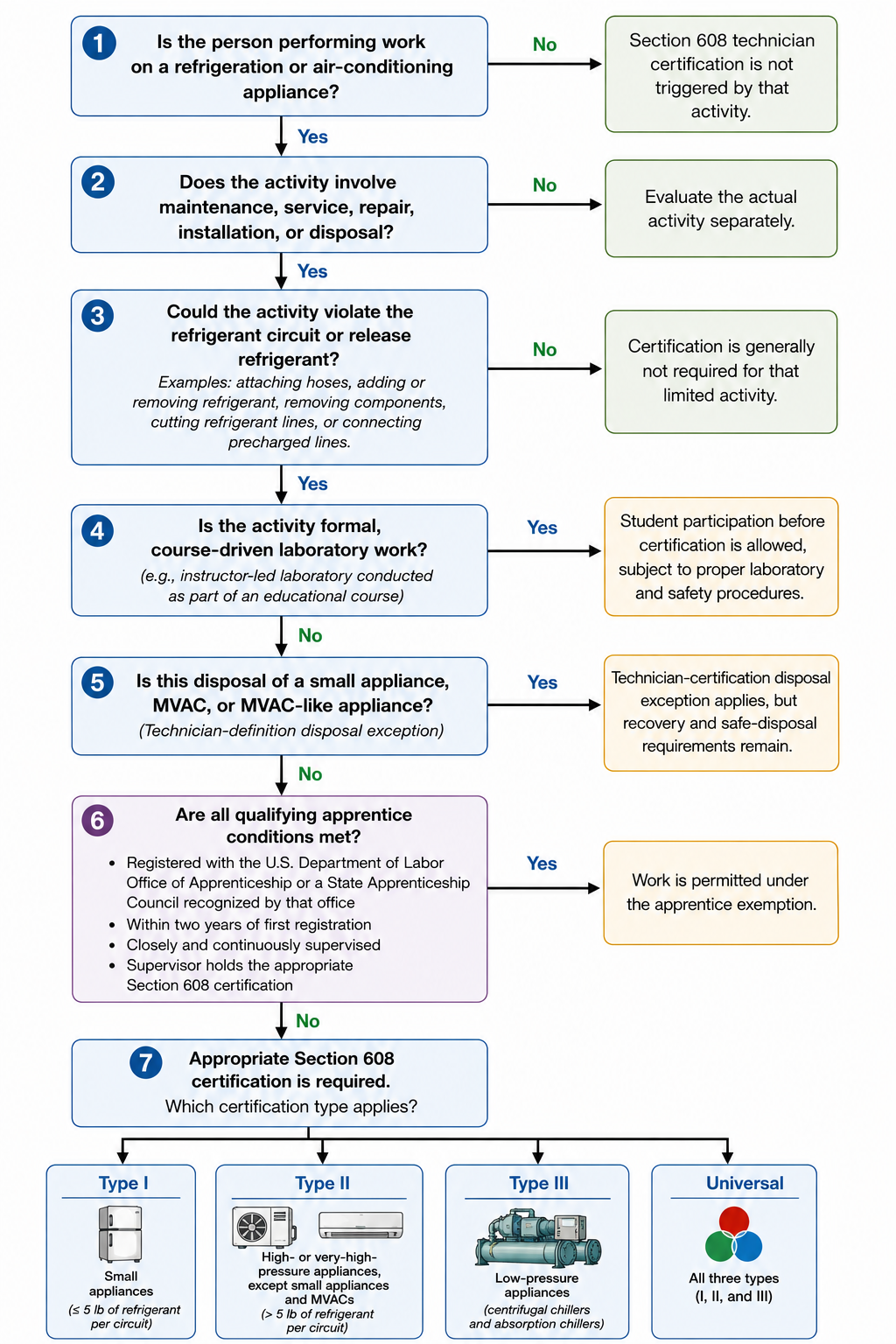
Figure 1.2.1 – Decision process for determining who must hold EPA Section 608 technician certification.
AI-generated instructional figure: It may contain visual inaccuracies. Use the accompanying lesson text and cited authoritative sources to verify technical and regulatory details.
EPA 608 Exam Focus
What Students Must Remember
- Certification is determined by the activity, not by the job title.
- Attaching or detaching hoses and gauges generally requires certification.
- Adding or removing refrigerant requires certification.
- Adding or removing refrigerant-circuit components requires certification.
- Cutting a refrigerant line requires certification.
- Connecting precharged mini-split lines requires certification.
- Owners and operators can be technicians when they perform covered work.
- Lack of payment does not create a Section 608 exemption.
- Painting, external electrical rewiring, pipe-insulation replacement, and unrelated nut-and-bolt tightening do not normally require certification.
- Work on a properly evacuated appliance is not normally expected to release refrigerant unless refrigerant is being added.
- Attaching gauges is not defined as “opening an appliance,” but it is still a technician activity requiring certification.
- Disposal of small appliances, MVACs, and MVAC-like appliances is excluded from the disposal portion of the technician definition.
- The disposal exception does not authorize venting.
- A qualifying apprentice must be officially registered.
- Apprentice status is limited to two years from first registration.
- An apprentice must be closely and continually supervised by a technician with the correct certification category.
- Formal course-driven laboratory work is allowed before certification.
- On-the-job training is not automatically formal laboratory work.
- EPA certification is based on appliance type; there is no separate EPA R-410A certification.
Typical Exam Question Patterns
Students may be asked:
- Whether connecting gauges requires certification.
- Whether a homeowner may add refrigerant without certification.
- Whether an installer connecting precharged lines must be certified.
- Which activities do not normally affect the refrigerant circuit.
- Whether properly evacuated equipment changes the certification determination.
- Which disposal activities are excluded from the technician definition.
- What qualifies a person as an apprentice.
- How long the federal apprentice status may last.
- What supervision an apprentice requires.
- Whether a student may perform formal laboratory work before certification.
- Whether an R-410A training card replaces Section 608 certification.
- Whether job title or equipment ownership controls the requirement.
High-Priority Distinctions
| Do Not Confuse | Correct Distinction |
|---|---|
| Technician activity and opening an appliance | Gauge connection is a technician activity even though it is not defined as opening |
| Student and apprentice | A student is not automatically a registered apprentice |
| Apprentice and uncertified helper | Apprentice status requires recognized registration and proper supervision |
| Formal laboratory and on-the-job training | Only genuine course-driven laboratory work receives the classroom allowance |
| Disposal exception and permission to vent | Recovery and safe-disposal duties remain |
| Refrigerant-specific training and EPA certification | Product training does not replace Section 608 certification |
| Ownership and exemption | Owners must be certified when they perform covered work |
| Purchasing and servicing | Authorization to buy refrigerant does not automatically authorize service work |
Common Mistakes and Confusing Points
Mistake 1: Assuming Only a Person With the Job Title “Technician” Needs Certification
The regulatory definition includes anyone performing covered work, including installers, owners, operators, and in-house maintenance personnel.
Mistake 2: Assuming Gauge Connection Is Only a Diagnostic Activity
Attaching and detaching gauges can release refrigerant and is specifically identified as technician activity.
Mistake 3: Confusing “Not Opening an Appliance” With “No Certification Required”
Gauge connection is not defined as opening an appliance, but certification is still generally required.
Mistake 4: Assuming a Homeowner May Service Personally Owned Equipment
Ownership does not create an exemption from Section 608 technician-certification requirements.
Mistake 5: Calling Any New Employee an Apprentice
The federal apprentice exemption requires recognized registration and close, continuous supervision.
Mistake 6: Assuming a Certified Coworker Somewhere in the Company Is Sufficient
The apprentice must be supervised during the work by a technician with the appropriate certification.
Mistake 7: Assuming School Enrollment Automatically Authorizes Field Work
Formal course-driven laboratory work is allowed, but on-the-job training requires certification or qualifying apprentice status.
Mistake 8: Treating the Small-Appliance Disposal Exception as Permission to Release Refrigerant
The exception concerns technician certification for disposal. Safe-disposal and refrigerant-recovery requirements still apply.
Mistake 9: Assuming an R-410A Certificate Is an EPA Credential
Refrigerant-specific training can be useful, but it does not replace Type I, Type II, Type III, or Universal certification.
Mistake 10: Applying a “Payment” Test to Section 608
Section 608 certification is generally based on the activity and potential refrigerant release, not on whether the person receives payment.
Concept-Check Questions
Question 1
Which factor primarily determines whether a person is a technician under Section 608?
A. The person’s official job title
B. Whether the person owns the appliance
C. Whether the activity could violate the refrigerant circuit and release refrigerant
D. Whether the person is paid for the work
Question 2
A facilities employee attaches a manifold gauge set to a rooftop air-conditioning unit. Which statement is most accurate?
A. Certification is not required because the employee is only measuring pressure
B. Certification is generally required because attaching and detaching gauges is a covered technician activity
C. Certification is required only if refrigerant is added
D. Certification is not required when the equipment belongs to the employer
Question 3
Which activity is not normally expected to violate the refrigerant circuit?
A. Removing refrigerant from an appliance
B. Cutting a refrigerant line
C. Rewiring an external electrical circuit
D. Connecting a precharged refrigerant line
Question 4
Which statement about connecting gauges is correct?
A. It is defined as opening an appliance and never requires certification
B. It is not defined as opening an appliance, but it generally requires certification
C. It requires certification only on low-pressure appliances
D. It is exempt when performed by an equipment owner
Question 5
A newly hired employee is called an apprentice by the employer but is not registered with a recognized apprenticeship program. May that employee recover refrigerant under the federal apprentice exemption?
A. Yes, if the employee has worked less than two years
B. Yes, if another certified technician works for the same company
C. No, because recognized apprentice registration is required
D. No, because apprentices may never perform refrigerant work
Question 6
Which condition is required for a registered apprentice to perform Type II work before certification?
A. The apprentice must be supervised remotely by any certified technician
B. The apprentice must be closely and continually supervised by a technician holding the appropriate Type II or Universal certification
C. The apprentice must purchase the refrigerant personally
D. The apprentice must have completed four years of registration
Question 7
Which statement best describes formal classroom laboratory work?
A. It may be performed before certification as genuine course-driven laboratory instruction
B. It is prohibited until every student earns Universal certification
C. It includes all paid internship work performed for customers
D. It eliminates all recovery and safety requirements
Question 8
A mechanic removes a compressor after another properly certified technician has recovered the refrigerant and properly evacuated the appliance. Which statement is most accurate?
A. The compressor removal is generally not expected to release refrigerant, but adding refrigerant later requires certification
B. The mechanic may add refrigerant because the appliance was previously evacuated
C. Proper evacuation eliminates all future Section 608 requirements
D. Certification is never required for compressor work
Question 9
Which statement about disposal of a small appliance is correct?
A. The technician-definition disposal exception permits refrigerant venting
B. Section 608 never regulates small-appliance disposal
C. The disposal activity has a technician-certification exception, but refrigerant recovery and safe-disposal requirements remain
D. Only the appliance owner may recover the refrigerant
Question 10
A homeowner connects precharged refrigerant lines while installing a mini-split. Which statement is most accurate?
A. Certification is not required because no service company is involved
B. Certification is not required if the equipment is newly purchased
C. Section 608 certification is required because connecting the refrigerant lines can violate the refrigerant circuit
D. Only an R-410A training certificate is required
Answers and detailed explanations will be provided in
1.9 - Answers and Explanations.md.
Section Summary
Section 608 certification is determined by the activity being performed and the likelihood that the activity could violate the refrigerant circuit and release refrigerant.
Certification is generally required for:
- Attaching or detaching gauges and hoses.
- Adding or removing refrigerant.
- Adding or removing refrigerant-circuit components.
- Cutting refrigerant lines.
- Connecting precharged refrigerant lines.
- Recovering, charging, servicing, or repairing covered appliances.
- Applicable disposal work.
Certification is generally not required solely for activities such as:
- Painting an appliance.
- Rewiring an external electrical circuit.
- Replacing external pipe insulation.
- Tightening unrelated nuts and bolts.
- Working on an appliance that has already been properly evacuated, provided refrigerant is not being added.
A registered apprentice may perform covered work only within the federal registration period and under close, continuous supervision by a technician holding the correct certification type. Formal course-driven laboratory work may be performed before certification, but ordinary on-the-job training requires certification or qualifying apprentice status.
The next section explains the certification categories used to match a technician’s credential to the appliance being serviced.
References
Current Regulatory Sources
-
U.S. Environmental Protection Agency, Section 608 Technician Certification Requirements, accessed August 5, 2026.
-
U.S. Environmental Protection Agency, Definitions of Section 608 Terms, accessed August 5, 2026.
-
U.S. Environmental Protection Agency, EPA’s Refrigerant Management Program: Questions and Answers for Section 608 Certified Technicians, accessed August 5, 2026.
-
U.S. Environmental Protection Agency, Homeowners and Consumers: Frequently Asked Questions, accessed August 5, 2026.
-
U.S. Environmental Protection Agency, Stationary Refrigeration Safe Disposal Requirements, accessed August 5, 2026.
-
U.S. Environmental Protection Agency, Refrigerant Sales Restriction, accessed August 5, 2026.
-
Electronic Code of Federal Regulations, 40 CFR § 82.152 — Definitions, accessed August 5, 2026.
-
Electronic Code of Federal Regulations, 40 CFR § 82.161 — Technician Certification, accessed August 5, 2026.